I’ve been sitting with this image for a while.
Not scrolling past it. Not screenshotting it for later.Just… stopping.
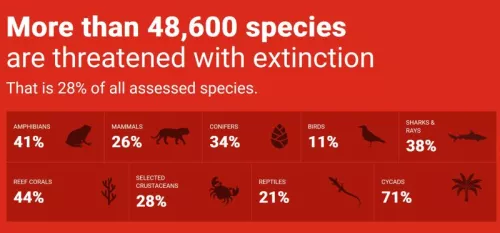
More than 48,600 species are threatened with extinction.Twenty-eight percent.
I read the sentence once. Then again.And then my eyes drifted not to the headline, but to the red.So much red.
It feels less like information and more like a warning lamp that refuses to turn off.
The Numbers Don’t Shock Me Anymore. And That Worries Me.
I wish I could say the numbers startled me.
But they didn’t.They landed with a dull weight instead.
Forty-one percent of amphibians.Seventy-one percent of cycads.Almost half of the reef corals.
I’ve seen variations of these figures before, in reports, presentations and carefully designed slides. What unsettles me now is not the scale alone, but how familiar this language of loss has become.
When did percentages replace grief?
When did extinction start sounding like a statistic instead of an ending?
I Start Thinking About Absence Instead of Species
The image lists categories: amphibians, mammals, birds, sharks, and conifers.
But my mind doesn’t picture groups. It jumps to gaps.
A wetland that no longer hums in the evening.A coastline quieter than it remembers being.A forest that looks intact but feels hollow.
Extinction, I realise, is not always dramatic.Sometimes it is a long, unremarkable silence settling in.
The Red Isn’t Just About Risk
This image is soaked in red urgency, alarm, and danger.
But the red also feels like something else.
Responsibility.
It asks an uncomfortable question without spelling it out:At what point does knowing become complicity?
Because once you’ve seen this you can’t unknow it.
I Notice Which Numbers Make Me Pause Longer
I keep stopping at cycads. Seventy-one percent.
Plants older than most of our ideas of civilisation are now clinging to survival.I imagine time folding in on itself, millions of years undone in a handful of decades.
And amphibians. Always amphibians.
Creatures that breathe through skin. That trust water. That assumes balance.
They are telling us something.They have been telling us for a while.
This Isn’t About the Future
What this image makes painfully clear is that this is not a story about what might happen.
This is now.
Not a distant collapse, not a speculative model.A present condition we are learning to live alongside.
And maybe that’s the most dangerous part, how easily catastrophe blends into the background once it becomes routine.
I Don’t Know What the Right Response Is
I don’t have a neat conclusion.
No checklist. No call framed as optimism.
All I have is this discomfort, this refusal of the image to let me be neutral.
Maybe that’s enough for now.
To sit with the numbers.To let them interrupt our scrolling.To allow them to rearrange how we see the everyday landscapes we move through.
Because extinction begins long before the last individual dies.It begins when disappearance stops startling us.
And this image, in all its red insistence, is asking us not to look away just yet.
🌻
Dr. D
Image credit: IUCN